Almost every business advertising online has a gap between two reports. The advertising platform shows how many leads arrived and how much each cost. The sales team knows how many deals closed. But almost nobody can connect the two and identify which campaign brought the customers who actually paid.
This gap does not come from a lack of data, but from the way leads move from campaigns to sales: manual copying from a file, an email forwarded by someone, or a form sent to a shared inbox. Each of these methods loses information about the lead’s source. In 2026, a new layer entered the picture: AI agents that can handle a lead from the moment it arrives. They too work well only when the foundation is organized.
This guide explains how to build a lead management setup in monday.com where every lead arrives automatically, remains linked to the campaign that generated it, receives an initial contact within minutes, and sends information back to the advertising platforms about what happened afterward.
Why Connecting Campaigns Directly to monday.com Changes the Picture
There are two reasons to connect campaigns directly to the CRM, and both directly affect revenue.
The first is speed. The best-known research in the field was published in Harvard Business Review in 2011 and examined 1.25 million leads at forty-two American companies. Companies attempting contact within an hour of an inquiry were almost seven times as likely to have a meaningful conversation with a decision-maker as companies contacting an hour later, and sixty times as likely as those waiting twenty-four hours or more. The same study found that the average response time, among companies that responded at all, was forty-two hours. The data is not new, but its central finding remains relevant: a lead waiting in an inbox loses value every hour.
The second is measurement. When every lead enters monday.com with details of the campaign that generated it, you can track it through to closing and allocate budget based on closed deals rather than lead counts.
How to Connect Each Lead Channel to monday.com
Each lead source requires a different connection method. Plan them together so all leads arrive on one board with a consistent structure.
| Lead Source | Recommended Connection | What to Preserve |
| Facebook and Instagram lead forms | monday.com’s native Meta integration | Meta lead ID |
| Website and landing page forms | Webhook or API directly to the board | UTM parameters and click ID |
| Google campaigns | Landing page form including the Google click ID | Google click ID |
| WhatsApp and phone calls | Connection through the telephony system or WhatsApp provider | Phone line number or campaign that generated the inquiry |
Leads from Meta Forms
monday.com has a native Meta integration. To activate it, first register monday CRM as an authorized CRM in the advertising account, under integrations and lead access in business settings. Also create a dedicated column on the board for the Meta lead ID and map the ID to it when connecting.
This column may look like a technical detail, but it is what later makes it possible to send lead quality information back to Meta. Without the ID, Meta cannot link the update it receives to the original lead.
Leads from the Website and Landing Pages
This is where most practical problems arise. A visitor arrives from a campaign with UTM parameters in the URL, browses several pages, and only then submits contact information. If the form does not preserve the parameters, the lead enters the system without any information about its source.
The solution is to add hidden fields to every website form, populated when the visitor first enters the website rather than only on the form page. These fields travel with the lead’s details to the monday.com board. Also preserve the Google and Meta click IDs added to the URL by the advertising platforms, because they link the lead to the specific click that generated it.
Leads from Google
In most Google campaigns, the lead arrives through a landing page, so the same principle applies: preserve the Google click ID in a hidden field and send it to the board. This is a requirement for importing offline conversions, explained below.
Essential Columns on the Leads Board
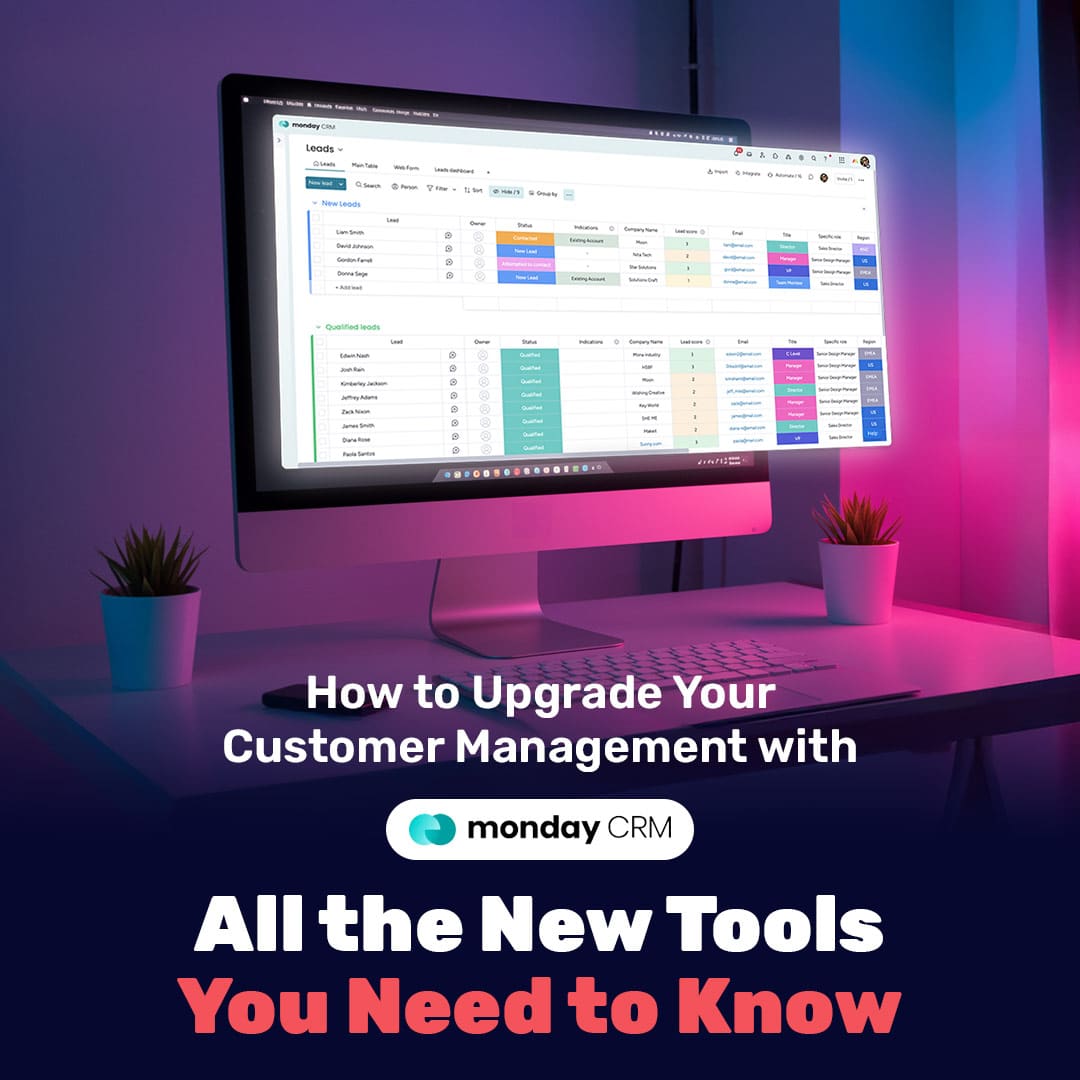
A properly built leads board lets you answer any business question without returning to Google Analytics or the advertising platforms. It is also the foundation the AI agents will work on.
| Column | What It Stores |
| Source | utm_source, such as google or facebook |
| Channel | utm_medium, such as cpc or paid_social |
| Campaign | utm_campaign |
| Ad or keyword | utm_content or utm_term |
| Click ID | gclid or fbclid |
| Meta lead ID | For Meta lead forms |
| Phone in international format | Includes country code, required for AI agents that make calls |
| Landing page | URL where the form was submitted |
| Arrival time and first contact time | For calculating response time |
| Status | Lead stage in the sales process |
| Deal value | For calculating return on investment |
Define consistent naming conventions for parameters in advance. If one campaign is tagged facebook, another Facebook, and a third fb, the dashboard will show three separate sources.
Closing the Loop: Sending Qualified Lead Information Back to Advertising Platforms
This is the part most businesses miss, and it is also the part with the greatest effect on campaign performance.
Meta and Google advertising platforms optimize for the event reported to them. If they receive only a “lead” event, they will find the people most likely to complete a form, who are not necessarily the people who will buy. A campaign generating many cheap, irrelevant leads will look excellent in the advertising platform and poor in sales.
monday.com makes it possible to address this. The Meta integration includes an automation recipe that sends an event to the Conversions API when lead status changes, using the pixel and the lead ID in the column. When a representative marks a lead as “qualified” or “closed,” Meta receives the information and can learn which audiences produce actual customers.
The principle is similar for Google: leads with a preserved Google click ID can be reported back as offline conversions through an integration tool or API connection. In both cases, the same condition applies: board statuses must be current. An outdated status sends incorrect information to advertising platforms, hurting performance rather than improving it.
Built-In AI Agents: What monday.com Can Do with a Lead on Its Own
In May 2026, monday.com transformed its platform into an AI-powered work platform. At its center are built-in agents that any team member can configure and activate without a technical background. According to the company, agents work with live data from all departments within the permissions, security, and controls already defined in the organization. For lead management, the practical meaning is that some work previously dependent on a representative’s availability can happen as soon as the lead arrives.
A Sales Agent That Calls the Lead
monday CRM includes an AI Sales Agent activated directly from the leads board. Setup begins with a short task description. monday.com’s support documentation includes an example directly relevant to this article: call incoming demo inquiries within five minutes, establish budget and timing, and check interest in a follow-up meeting. From this description, the agent generates its own name, opening line, instructions, voice, language, and SMS template.
Every call is recorded as an activity on the lead’s timeline, with a summary and link to the full transcript, so the representative continuing the conversation knows exactly what was said. Regarding security, monday.com cites AES-256 encryption at rest, TLS 1.3 in transit, and a policy that AI providers do not retain the information.
Two practical points before activation:
Country code: every phone number on the board must include a country code; otherwise, routing will fail and the call will not go through. Israeli forms storing numbers in local format need an automation or field that adds the code before the agent calls.
Language and regulation: before using the agent with customers in Israel, check Hebrew call quality and the regulatory requirements for automated and recorded calls.
AI Actions Within Automations
Not every lead interaction requires an agent that calls. monday CRM also offers AI actions configured by dragging and dropping, without code. They can automatically classify leads, extract information from free text, and trigger follow-up actions. For example, sentiment detection classifies text as positive, negative, or neutral, while the writing assistant drafts follow-up messages based on lead data and communication history. In practice, a lead leaving a long message in a form can reach a representative already classified by subject, urgency, and tone.
An Agent That Finds New Leads
Another agent, AI Lead Agent, works in the opposite direction: instead of handling incoming leads, it finds, adds, and enriches new leads based on the ideal customer profile at a defined frequency. It is still in beta. During this period, it is available across the organization, and anyone with access to monday CRM can edit or delete it. monday.com also warns that changes to board structure over time may cause lead creation errors. It therefore complements campaign leads rather than replacing them.
Cost consideration: monday.com’s AI capabilities consume credits from the plan’s monthly allowance. An agent calling every incoming lead involves intensive usage, so define in advance which leads trigger it, for example only leads from certain campaigns or only outside business hours.
Automations and Agents to Configure from Day One
Automatic assignment: assign every new lead to a representative by region, specialty, or rotation.
Immediate initial contact: notify a representative or activate an agent that calls or sends a message within the first few minutes, especially outside business hours.
Automatic classification: use AI actions to classify the lead by inquiry content so the representative starts with full context.
Unattended lead alert: if the status has not changed within a defined period, send an alert to the manager.
Duplicate detection: if a lead already exists with the same phone number or email, update it with the new inquiry rather than create it again.
Mandatory status updates: a lead cannot be closed without recording a reason. This feeds the dashboard, feedback to advertising platforms, and the agents themselves.
The Dashboard: What a Marketing Manager Needs to See
When leads arrive with a source and status, you can build a monday.com dashboard displaying three different metrics: cost per lead, cost per qualified lead, and cost per deal. The difference between them is usually the most important insight in the report. A campaign with a low cost per lead and high cost per deal brings quantity rather than quality. A campaign with a high cost per lead and a high close rate may be the most profitable in the account.
To calculate these metrics, you also need spending data. monday.com’s Meta integration can import active campaigns into a dedicated board, while Google data can be brought in through integration tools.
External Agents: Working with the Leads Board from Claude or ChatGPT
Beyond built-in agents, monday.com has also opened its platform to external AI agents. The connection uses MCP, a protocol allowing tools such as Claude, ChatGPT, Cursor, and Microsoft Copilot to connect securely to account data. According to monday.com, MCP is preinstalled in every account.
For lead management, this means a marketing manager can ask natural-language questions such as “Which leads from last week’s campaign have not been handled yet?” or “What was the close rate by source last month?” and receive an answer directly from the board without building a report.
Three points to understand before enabling such a connection:
Permissions: the connection respects all existing permissions. An agent acting for an employee cannot see more than that employee can see in the interface. There is no shared service account, and each connection belongs to one user.
Organizational control: account administrators can enable or disable external agents’ access through the administration panel. In an organization holding sensitive customer information, make this a conscious decision rather than leave the default setting.
Quotas: actions performed by the agent count as API calls and fall within the account’s daily quota.
In March 2026, monday.com also announced infrastructure allowing AI agents acting on people’s behalf to register, authenticate, and operate directly on the platform. Agents can also respond to changes in real time through webhooks and trigger automations. The practical implication: a properly built leads board becomes infrastructure external agents can work with, as well as the sales team.
Common Mistakes
Parameters lost along the way. Redirects, moving between domains, or a form opening in a separate window can remove UTM parameters. Test every conversion path yourself before launching a campaign.
One form for all sources, without hidden fields. This creates a board full of leads whose origins cannot be identified.
A separate leads board for every channel. This initially looks organized, but prevents comparison between channels and creates duplicates.
Statuses that are not updated. Without updated statuses, there is no reliable dashboard, no accurate reporting back to advertising platforms, and no basis for the agents to work from.
Changing board structure after agents are running. Agents and integrations rely on column names and types. Changing or deleting a column without checking its dependencies can silently break the workflow without anyone noticing.
Activating an agent on disorganized data. An agent calling leads without country codes, or classifying leads using statuses nobody updates, creates work rather than saves it. Agents add value only after the foundation works.
Frequently Asked Questions
Can Facebook lead forms connect to monday.com without an external tool?
Yes. monday.com has a native Meta integration. Register monday CRM as an authorized CRM in business settings and map the lead ID to a dedicated column.
What is the difference between UTM parameters and a click ID?
UTM parameters describe the campaign, channel, and ad, and you define them. A click ID is generated automatically by the advertising platform and links a lead to a specific click, which is why it is needed for reporting conversions back.
Why report closed leads to Meta and Google?
So the algorithm optimizes for actual customers rather than form submissions. This is one of the steps with the greatest effect on lead quality.
Can an AI agent call a lead as soon as it arrives?
Yes. monday CRM has a built-in sales agent that calls leads, gathers qualification information, and records a summary and transcript in the lead record. Before activation in Israel, check Hebrew call quality and regulatory considerations.
Can we ask Claude or ChatGPT questions about leads in monday.com?
Yes, through monday.com’s MCP, which is preinstalled in every account. Access is limited to the connected user’s permissions, and the account administrator can enable or disable it.
Is this suitable for a small business too?
Yes. Even a business with a few dozen leads per month benefits from an automatic connection and preserved lead source. Feedback to advertising platforms and AI agents deliver their full value when lead volume is substantial.
Connecting Marketing, monday.com, and AI at Web3D
At Web3D, the digital marketing department and monday.com implementation department work under the same roof, so we build lead management from both directions: the campaign generating the lead and the board managing it through to closing. Combining Google and Meta campaign management, monday CRM implementation, and integration development makes it possible to plan parameters, forms, automations, agents, and feedback to advertising platforms as one system. This is especially important now, as AI agents begin doing part of the work and board data quality determines how helpful they will actually be. To learn which campaign really brings customers and how to let AI handle leads without losing control, read more about [monday.com implementation at Web3D] and [measurement and CRM implementation].